
Introduction to Journey of Oil Refining
Oil refining, a complex industrial process, plays a crucial role in converting crude oil into a vast array of valuable petroleum products. From the gasoline powering our vehicles to the plastics and chemicals used in our daily lives, oil refining is an essential part of modern society. This article will take you through the various stages of the oil refining process, shedding light on how this intricate process transforms crude oil into a diverse range of refined products.Exploration and Drilling
The journey of oil refining begins with the exploration and drilling of oil wells. Geologists and geophysicists study roock formations and conduct seismic surveys to locate potential oil reserves. Once a promising site is identified, drilling rigs are deployed to extract crude oil from deep within the Earth's crust.Transportation and Storage
After extraction, the crude oil is transported via pipelines, tankers, or trucks to refineries. En route, the oil may be stored temporarily in large tanks or storage facilities to ensure a continuous supply to the refineries.Pre-Processing
Upon arrival at the refinery, crude oil undergoes pre-processing to remove impurities such as water, salt, and solid particles. The oil is heated to high temperatures and then passed through separators and desalters, resulting in a cleaner, more homogeneous feedstock for the refining process.Distillation
The heart of the refining process is distillation, where crude oil is separated into its various components based on their boiling points. Inside a towering distillation column, the crude oil is heated at the bottom, and the resulting vapors rise through a series of trays or packing materials. Lighter hydrocarbons, such as gases and gasoline, rise to the top, while heavier components like diesel, kerosene, and lubricants settle in the lower sections.Conversion Processes
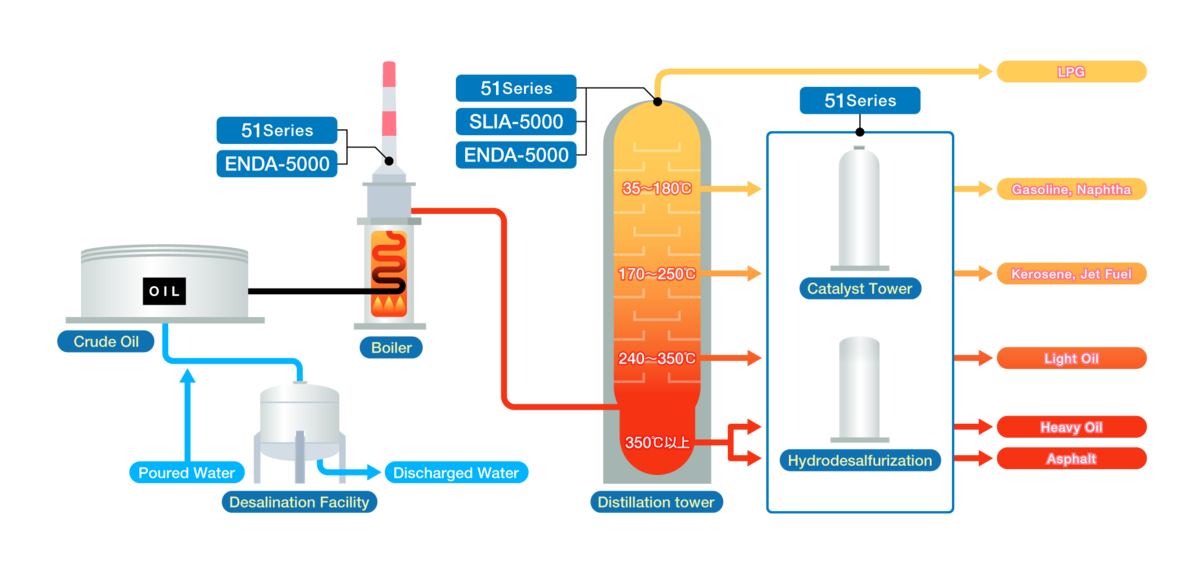
To maximize the yield of valuable products, some heavier fractions from the distillation process are subjected to conversion processes. Two common methods are:
a) Cracking: In this process, heavy hydrocarbons are broken down into lighter ones by either thermal cracking (using high temperatures) or catalytic cracking (using a catalyst). This yields an increased production of gasoline and other valuable products.
b) Reforming: In reforming, molecules are restructured to enhance the octane rating of gasoline. This process improves the fuel's performance while maintaining emissions standards.Treatment Processes
To meet stringent product specifications and environmental regulations, the refined products undergo treatment processes, including:
a) Hydrotreating: Removes sulfur, nitrogen, and other impurities from gasoline, diesel, and other products, reducing harmful emissions.
b) Isomerization: Converts straight-chain hydrocarbons into branched-chain hydrocarbons, which improves the performance of gasoline.
c) Hydrocracking: Combines hydrogen with heavier hydrocarbons to produce lighter and more valuable products like gasoline and diesel.Blending and Distribution
After undergoing the refining process and passing rigorous quality control tests, the various petroleum products are blended to meet specific market demands. The final products, including gasoline, jet fuel, diesel, heating oil, and petrochemical feedstocks, are then transported through pipelines, trucks, or ships to distribution centers and ultimately to consumers.
Conclusion
The oil refining process is a remarkable feat of engineering and chemistry that transforms crude oil, a raw material extracted from the earth, into an extensive range of valuable products. From gasoline that fuels our vehicles to the building blocks of modern life, oil refining plays a vital role in our daily existence. As technology and demand evolve, refineries continue to innovate and optimize their processes, striking a delicate balance between meeting consumer needs and environmental sustainability.


0 Comments